If you own property along the Wasatch Front, there's a good chance you're dealing with a slope. From Draper's hillside lots to the benches above Farmington and Bountiful, Utah's terrain creates real challenges — and real opportunities — for homeowners who want to maximize their outdoor living space. Retaining walls are one of the most common hardscaping projects we take on, and for good reason: a well-built wall turns an unusable hillside into a flat, functional yard.
But not all retaining walls are created equal. The two most popular options in Utah — boulder walls and block walls — differ significantly in cost, appearance, structural capacity, and long-term performance. This guide breaks down both options with real pricing, permit considerations, and the drainage details that separate a wall that lasts 30 years from one that fails in 5.
Boulder Retaining Walls: $40–$50 per Square Foot
Boulder retaining walls use large, naturally shaped rocks — typically Utah limestone, sandstone, or granite — stacked and interlocked to hold back soil. They're the most popular choice for residential slopes under 4 feet along the Wasatch Front, and for good reason.
Why Homeowners Choose Boulder Walls
Natural aesthetics. Boulder walls blend into Utah's landscape in a way manufactured materials can't replicate. In mountain-adjacent neighborhoods across Draper, Farmington, and Bountiful, a boulder wall looks like it belongs. The stone weathers over time, developing character rather than deteriorating.
Drainage-friendly by design. Because boulders aren't mortared together, water passes through the gaps naturally. In a state where spring snowmelt dumps thousands of gallons of water into hillsides over a 6-week window, this passive drainage is a significant advantage. The spaces between boulders act as built-in weep points, reducing hydrostatic pressure behind the wall without additional drain systems in many cases.
No mortar required. Most boulder walls rely on gravity and the interlocking weight of the stone to hold position. A 2,000-pound boulder isn't going anywhere. This simplifies construction and eliminates the mortar joints that crack during Utah's freeze-thaw cycles. The trade-off is that boulder placement requires skilled equipment operators — placing rock with an excavator so each boulder locks against its neighbors is as much art as engineering.
Boulder Wall Limitations
Boulder walls have a practical height limit of about 4 feet for most residential applications. Beyond that, the base width required to maintain structural integrity starts consuming significant yard space. A 6-foot boulder wall might need a 6-to-8-foot-wide base, which defeats the purpose of reclaiming usable area on a tight lot. For taller requirements, block walls or a tiered boulder approach (more on that below) are better options.
Material sourcing also affects pricing. Utah has excellent local stone — quarries along the Wasatch Range produce high-quality limestone and sandstone — but delivery costs increase with distance. Projects in the Salt Lake Valley typically fall in the $40–$45/sq ft range, while properties higher in the foothills may reach $50/sq ft due to access difficulty and equipment logistics.
Block Retaining Walls: $90–$110 per Square Foot
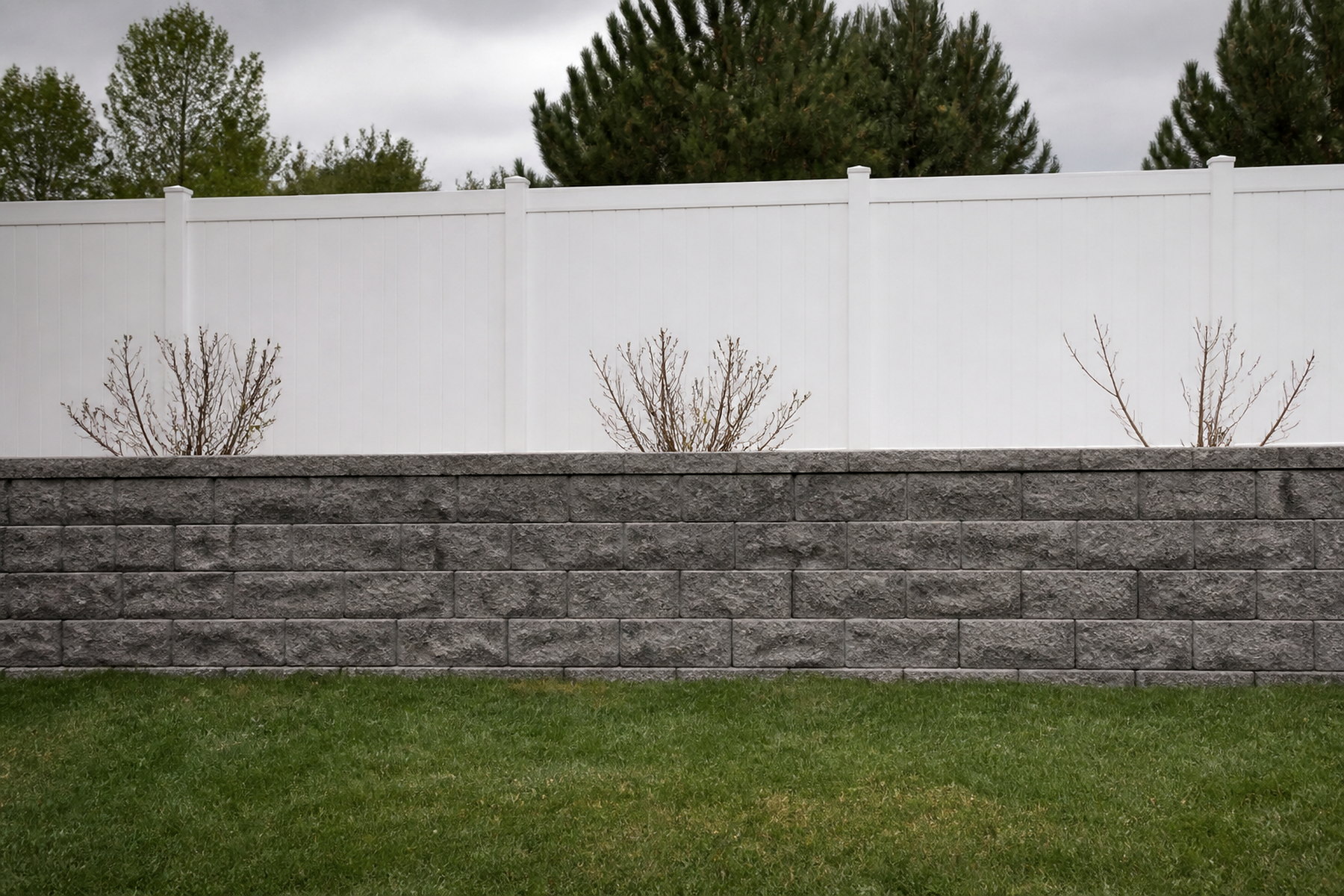
Block retaining walls use engineered concrete masonry units (CMU) or segmental retaining wall blocks — precision-manufactured units designed to interlock and resist soil pressure through engineering rather than raw mass. They're the right choice when structural performance, height, and clean aesthetics are priorities.
Why Block Walls Cost More — and Why It's Worth It
Engineered precision. Block walls require a compacted gravel base (typically 6–8 inches deep), leveling pads, and exact coursing. Every block is placed to specification, with pins or lips locking each course to the one below. For walls over 4 feet, geogrid reinforcement — layers of high-tensile fabric extending back into the retained soil — is installed at engineered intervals. This geogrid ties the wall to the earth behind it, distributing soil pressure across a wide zone rather than concentrating it at the wall face.
Height capability. Properly engineered block walls can reach 10, 15, even 20+ feet. This makes them the only practical option for significant grade changes — turning a steep hillside into multiple usable levels with a single wall system.
Clean, modern look. Block walls offer straight lines, consistent texture, and color options that integrate seamlessly with paver patios, concrete flatwork, outdoor kitchens, and other hardscape features. If you're building a complete outdoor living space with multiple elements, block walls create visual continuity that boulders can't match.
Block Wall Cost Breakdown
The $90–$110/sq ft range reflects the full installed cost including excavation, compacted base, block material, geogrid (for walls over 4 feet), drainage system, backfill, and compaction. Material alone accounts for roughly 35–40% of the total cost. Labor and equipment make up the rest — block walls are labor-intensive, requiring precise leveling, cutting, and backfill compaction at every course.
Wall caps (the finished top course) add aesthetic value and protect the wall from water infiltration. Premium cap styles can add $8–$15 per linear foot to the project but make a significant visual difference.
How Height Affects Cost and Permits
Retaining wall cost doesn't scale linearly with height — it accelerates. A wall that's twice as tall doesn't cost twice as much; it costs roughly three times as much. Here's why.
The Physics of Taller Walls
Soil pressure against a retaining wall increases with depth. A 2-foot wall holds back a manageable amount of force. A 6-foot wall holds back roughly nine times the lateral pressure of that 2-foot wall (pressure increases with the square of the height). This means taller walls need wider bases, more geogrid layers, deeper embedment below grade, heavier drainage systems, and more compacted backfill — all of which drive cost exponentially.
Utah Permit Requirements
Most Utah municipalities — including Kaysville, Layton, Farmington, Bountiful, Draper, Sandy, West Jordan, and Salt Lake City — require a building permit for retaining walls over 4 feet in exposed height. The permit process typically requires stamped engineered drawings from a licensed structural engineer, which adds $1,500–$3,000 to the project. Inspections during construction (footing, drainage, backfill, final) are standard.
Walls within 2 feet of a property line or that support a surcharge (like a driveway, structure, or slope above the wall) may require permits even under 4 feet. Always confirm with your local building department before construction begins.
The Tiered Wall Strategy
One of the most effective approaches for managing steep grades is building two or more shorter walls with flat terraces between them, rather than one tall wall. Two 3-foot walls with a 4-foot planting terrace between them often costs less than a single 6-foot wall, avoids permit requirements in most jurisdictions, creates usable planting space on each tier, and reduces drainage pressure on any single wall. We use this approach frequently on hillside properties where a single tall wall would require engineering and permitting that pushes the project beyond the homeowner's budget.
Drainage Is Everything
This is the section most retaining wall articles gloss over, and it's the single most important factor in whether your wall lasts 5 years or 50. The majority of retaining wall failures we see in Utah trace back to one problem: water.
Utah's Drainage Challenge
Utah's soils along the Wasatch Front are predominantly clay-based. Clay is essentially waterproof — it absorbs moisture slowly, swells when saturated, and doesn't drain. When spring snowmelt sends water downhill into the soil behind a retaining wall, that water has nowhere to go. It builds up, creating hydrostatic pressure — literal water weight pushing against the back of the wall. A cubic foot of saturated soil weighs 20–30% more than dry soil. Multiply that across the entire face of a wall, and the forces are enormous.
Add Utah's freeze-thaw cycling to the equation: water trapped behind the wall freezes, expands, pushes the wall outward. It thaws, the wall settles back slightly. Over 50–80 cycles per winter, this creates progressive displacement — the wall leans, cracks, and eventually fails.
Non-Negotiable Drainage Components
Drain tile (perforated pipe). A 4-inch perforated PVC pipe wrapped in filter fabric, installed at the base of the wall behind the first course. This pipe collects water at the lowest point and routes it to a daylight outlet at the end of the wall. No exceptions — every wall we build includes drain tile.
Gravel backfill. A minimum 12-inch zone of clean, angular drainage gravel (¾-inch minus) behind the wall, from base to within 6 inches of the top. This gravel zone creates a fast-draining channel that moves water down to the drain tile before it can build pressure against the wall face. Round river rock is not acceptable — it doesn't compact and can shift under load.
Filter fabric. Non-woven geotextile fabric separating the gravel backfill from the native clay soil. Without this fabric, clay particles migrate into the gravel over time, clogging the drainage system. This is a $0.15/sq ft material that prevents a $15,000 wall failure.
Weep holes. Openings at the base of block walls (every 4–6 feet) that allow any water reaching the wall face to pass through rather than building up. Boulder walls have natural weep capability through their gaps.
Choosing the Right Wall for Your Property
The boulder vs. block decision comes down to four factors: height, budget, aesthetics, and what the wall needs to integrate with.
Choose Boulder Walls When:
- The wall is under 4 feet. Boulder walls are structurally sound, cost-effective, and beautiful at this height range.
- You want a natural, rustic look. Properties adjacent to open space, mountain lots, and naturalistic landscapes look best with stone that matches the surrounding terrain.
- Budget is a primary concern. At $40–$50/sq ft vs. $90–$110/sq ft, boulder walls deliver significant savings — often 50% or more on total project cost.
- The slope is gradual. Gentle-to-moderate slopes where you need to create level areas but aren't fighting major grade changes are ideal for boulder walls.
Choose Block Walls When:
- The wall exceeds 4 feet. Block is the only practical option for significant height without consuming massive base width.
- You're building a complete outdoor living space. If the wall integrates with a paver patio, outdoor kitchen, fire pit area, or concrete flatwork, block walls create clean transitions and unified design.
- You need structural support for a load above. Driveways, structures, or heavy equipment near the top of the wall require the engineered capacity that block systems provide.
- You want a clean, modern aesthetic. Straight lines, consistent color, and architectural precision — block walls deliver a finished look that matches contemporary home design.
Consider a Combination
We frequently build projects that use both materials. A block wall creates the primary structural retention and integrates with the patio and hardscape design, while boulder walls handle secondary slopes and planting bed edges at a lower cost. This approach optimizes the budget without compromising structural integrity or aesthetics where each matters most.
What to Expect from the Installation Process
A properly built retaining wall isn't a weekend project. Here's what a typical residential retaining wall installation looks like:
- Site assessment and design (1–2 weeks). We evaluate the slope, soil conditions, drainage patterns, and access. For walls over 4 feet, engineering drawings are produced and permits pulled.
- Excavation and base preparation (1–2 days). The footing trench is excavated below frost line (18–24 inches in most of Utah), and compacted road base is installed in lifts.
- Wall construction (2–5 days). Depending on wall type, length, and height. Boulder walls move faster due to fewer precision requirements. Block walls require more time for leveling, cutting, geogrid installation, and backfill compaction at each course.
- Backfill and drainage (concurrent). Drainage gravel, drain tile, and filter fabric are installed as the wall goes up — not after. Backfill is compacted in 8-inch lifts to prevent settling.
- Finish and cleanup (1 day). Wall caps installed, daylight drains verified, grade established, and site cleaned.
Total project timeline for a typical residential retaining wall: 2–4 weeks from signed contract to completion, depending on permit requirements and wall complexity. For context on how retaining walls compare to other outdoor projects, see our concrete vs. pavers comparison.
Get a Free Retaining Wall Quote
Every retaining wall project is different. Soil conditions, slope angle, access, wall height, and material choice all affect the final price. We provide free on-site consultations where we assess your property, discuss boulder and block options, and deliver a detailed quote with no pressure and no surprises.
Whether you're terracing a hillside in Draper, building a level patio area in Farmington, or stabilizing a slope in Sandy, we'll help you choose the right wall type, design it for Utah's conditions, and build it to last.
Request your free retaining wall quote or call us at (801) 391-0906. We serve homeowners throughout Davis, Salt Lake, and Utah Counties.