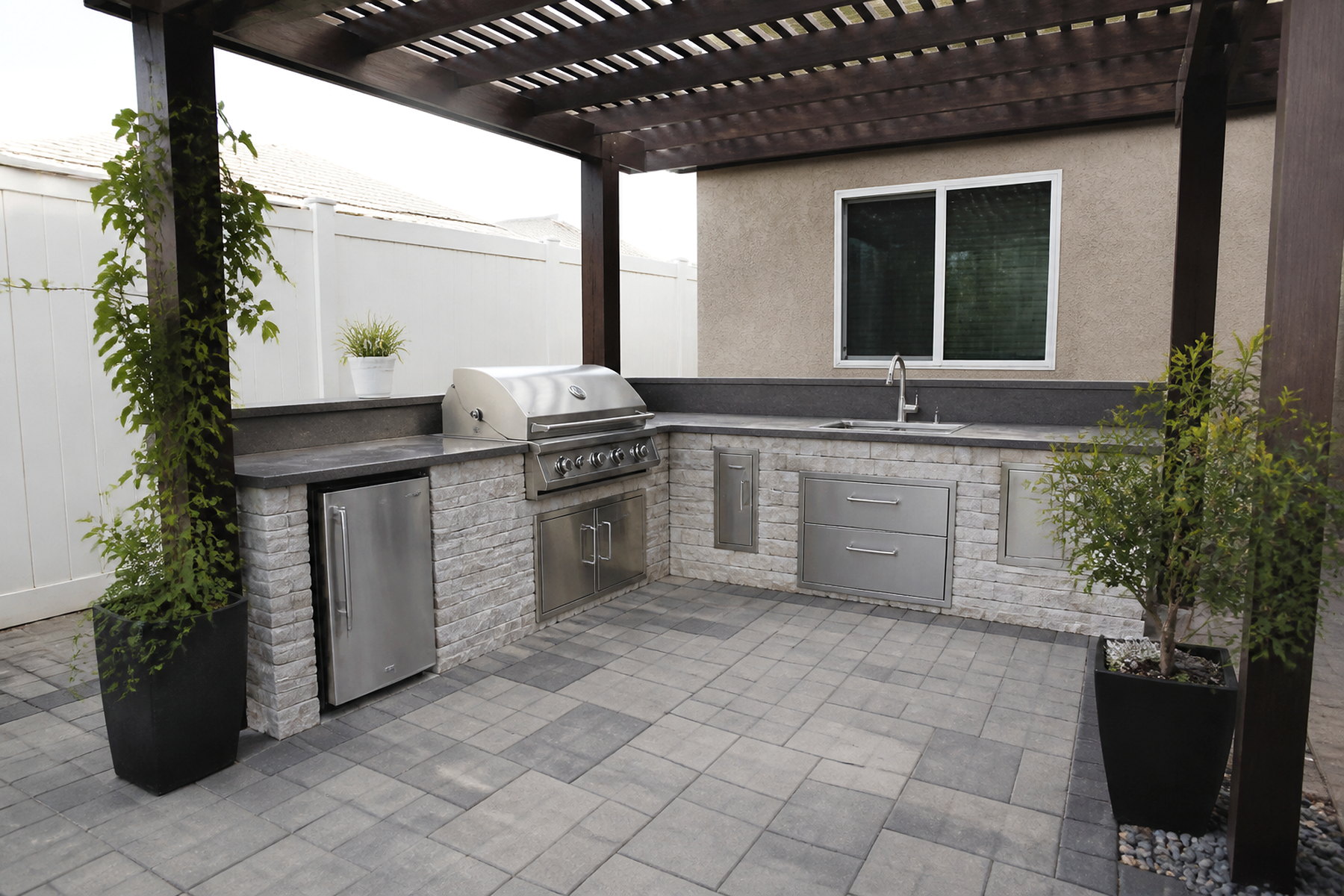
Utah's outdoor season runs roughly April through October — seven full months of usable backyard time. That's more than half the year where your outdoor space functions as an extension of your home, and the best investment you can make is designing it to work that way. A well-planned outdoor living space doesn't just look good. It adds real, functional square footage to your property, increases your home's resale value, and fundamentally changes how your family uses the yard.
Here's what Utah homeowners are building in 2026 — with real cost ranges, material recommendations, and design strategies we use on projects across the Wasatch Front every week.
Paver Patios — The Foundation of Every Outdoor Space
Every outdoor living project we design starts with one question: what's the patio surface? The patio is the foundation of everything else — your outdoor kitchen sits on it, your fire pit anchors it, your furniture lives on it. Get the patio right and everything else falls into place.
Paver patios are the top choice for Utah outdoor living spaces, and for good reason. Unlike poured concrete, pavers handle Utah's freeze-thaw cycles without cracking. The joints between pavers flex with ground movement instead of fighting it, which means your patio stays intact through 50–80 freeze-thaw cycles per year while a concrete slab develops cracks within the first few seasons.
Cost and Material Options
Standard interlocking concrete pavers run $20–$24 per square foot installed, including base preparation, compaction, pavers, and polymeric sand joints. Premium pavers — Belgard Origins, Catalina Slate, or Lost Face Pavers — range from $24–$32 per square foot installed. Both Belgard and Lost Face are popular brands in Utah because they're engineered for our elevation, UV exposure, and temperature swings.
For a typical 300 square foot patio (roughly 15' x 20' — enough for a dining set and a couple of lounge chairs), you're looking at $6,000–$9,600 depending on materials and layout complexity.
Patterns and Colors
The three most requested paver patterns in Utah right now are herringbone (best structural integrity, ideal for areas with foot traffic and furniture loads), running bond (clean and modern, installs efficiently), and random/ashlar (multiple paver sizes laid in a natural, organic pattern). Earth tones — tans, warm browns, sandstone — remain dominant, but cool grays are gaining ground fast, especially on modern homes in communities like Draper, Sandy, and Farmington.
Explore our full breakdown of materials and styles in our Best Paver Styles for Utah Homes guide, or compare pavers to concrete in our Concrete vs. Pavers article.
Outdoor Kitchens ($8,000–$12,000+)
An outdoor kitchen takes your patio from a sitting area to a legitimate living space. Utah's dry summer climate is perfect for outdoor cooking — you can grill from April through October without worrying about rain, and the low humidity means food prep outdoors is actually more comfortable than standing over a hot stove inside.
What a Typical Build Includes
A standard outdoor kitchen starts with a built-in grill island — a gas grill (usually 30"–36") set into a block or stone-veneer surround with countertop space on both sides. Add a stainless steel access door for propane or storage, and you've got a functional cooking station for $8,000–$10,000.
From there, upgrades stack quickly: a sink with running water ($800–$1,500 added), an outdoor-rated mini fridge ($500–$1,200), bar seating with a raised countertop ($1,500–$3,000), and built-in drawers or trash pullouts. A fully loaded outdoor kitchen with all the extras can reach $15,000–$20,000+, but the $8,000–$12,000 range covers what most Utah homeowners build.
Planning Essentials
Two things need to happen early in the design: gas line routing and electrical planning. If you're running a natural gas grill (which we recommend over propane for permanent kitchens), the gas line needs to be trenched and connected before the patio base goes down. Same with electrical for lighting, outlets, or a fridge. Plan these during the design phase, not after the pavers are laid.
Pair your outdoor kitchen with a pergola or louvered roof cover for shade during Utah's intense summer sun. A south-facing kitchen without shade hits 100°+ surface temperatures by mid-afternoon in July. A cover makes the space usable all day. See our full hardscaping services for what we build.
Fire Pits & Seat Walls
If there's one feature that gets more use than any other in Utah backyards, it's a fire pit. Utah nights cool off fast — even in July, temperatures drop into the 60s after sunset, and by September you're looking at upper 40s and 50s after dark. A fire feature extends your evening outdoor time by two to three months on each end of the season.
Gas vs. Wood-Burning
Gas fire pits run $2,500–$5,000 installed, depending on size, materials, and whether you're tapping into an existing gas line or running a new one. They light instantly, produce no smoke or ash, and give you flame control with a dial. For paver patio installations where the fire pit is close to seating and dining, gas is almost always the better choice.
Wood-burning fire pits cost $1,500–$3,000 installed — less expensive upfront, and some homeowners prefer the ambiance of real wood fire. The tradeoff is smoke management (Utah's inversion-season burn restrictions apply), ash cleanup, and ember risk near structures. Wood-burning pits work best in open yard areas set away from the main patio.
Seat Walls
Seat walls are the design feature most homeowners don't think to ask for — until they see one. A seat wall is a low masonry wall (typically 18"–20" tall) built from the same block or stone as your patio border, capped with a smooth stone or concrete cap for comfortable seating. They cost $150–$250 per linear foot depending on material and cap style.
A 12-foot curved seat wall around one side of a fire pit adds seating for 5–6 people without a single piece of furniture. It defines the fire pit zone, creates visual enclosure, and gives the space a permanent, built-in feel that chairs and benches can't match. Seat walls also double as raised planter borders or transitions between patio elevations.
Retaining Walls as Design Features
Retaining walls aren't just for holding back hillsides. In outdoor living design, they're one of the most versatile tools for creating depth, defining zones, and adding visual interest to flat or sloped yards alike.
Boulder Walls
Tiered boulder walls create natural-looking planting beds that step up a slope, turning an unusable hillside into a layered garden with distinct planting zones. This approach is especially common in sloped yards across Draper, Bountiful, and Farmington, where hillside lots are the norm. Boulders sourced from local quarries blend with Utah's natural landscape and weather beautifully over time.
Block Retaining Walls
Segmental block walls — built from engineered retaining wall blocks — integrate seamlessly with paver patios for a cohesive hardscape design. Use them to create raised patio borders, terraced seating areas, or level transitions between a patio and a lower lawn area. Block walls can match or complement your paver color for a unified look across the entire outdoor space.
We cover costs, materials, and design options in detail in our Retaining Walls Utah Cost Guide. For project planning, visit our hardscaping services page.
Artificial Turf + Hardscape Combos
The combination of artificial turf and paver hardscaping is one of the strongest design trends in Utah outdoor living right now — and it's driven by practicality as much as aesthetics. Utah's ongoing water conservation push, combined with the reality that natural grass demands 40–60 inches of water per year in our climate, makes turf-and-paver combos a smart financial and environmental play.
Popular Configurations
- Paver patio transitioning to turf yard: The most common setup. A paver patio handles the dining and cooking zone, then transitions to a turf lawn for kids, pets, and open space. Clean edge detail between paver and turf creates a sharp, finished look.
- Putting greens with paver borders: Backyard putting greens framed by paver walkways or borders. Functional and great-looking — a popular request from homeowners in Sandy and Draper.
- Turf strips between paver ribbons: A modern design where alternating strips of turf and linear paver bands create a contemporary, architectural look. Zero water, zero mowing, and visually striking from every angle.
The result is a yard that requires zero watering, zero mowing, and looks pristine year-round — the perfect complement to a hardscape-forward outdoor living space.
Permanent Landscape Lighting
Lighting is the element that separates a good outdoor space from one you actually use after dark. Without it, your patio, fire pit, and kitchen are limited to daylight hours. With a proper permanent lighting system, you extend usable hours well into the evening every single night of the season.
Key Lighting Types
- LED path lights: Low-profile fixtures along walkways, patio edges, and transitions between hardscape zones. Provides safe navigation and defines the layout of your space after dark.
- Uplighting: Ground-mounted fixtures aimed upward on retaining walls, trees, or architectural features. Creates dramatic shadows and highlights the vertical elements of your landscape.
- Patio string lights: Strung between posts, pergola beams, or the house. Sets the ambiance for dining and entertaining — one of the most requested lighting features we install.
- Step and wall lights: Recessed into seat walls, retaining walls, or patio steps for subtle, functional illumination exactly where you need it.
Modern LED landscape lighting runs on minimal electricity — a full outdoor lighting system typically costs $5–$15 per month to operate. It also adds a layer of security by eliminating dark zones around your property. The upfront investment pays for itself in extended use, safety, and property value.
The best outdoor spaces combine multiple elements: a paver patio for dining, turf for the kids, a fire pit for evenings, and lighting to tie it all together. Each feature is good on its own — but the real transformation happens when they work as a system, designed together from the start.
Start Planning Your Outdoor Space
The best time to start planning a Utah outdoor living project is late winter or early spring. Scheduling fills fast once the ground thaws, and getting your design locked in by March or April means construction can start as soon as conditions allow — giving you a finished space to enjoy by early summer.
At Sol Scapes, we handle every element covered in this guide: paver patios, outdoor kitchens, fire pits, retaining walls, artificial turf, permanent lighting, and concrete flatwork. We design and build complete outdoor living spaces across Davis, Salt Lake, and Utah Counties — from the initial concept through final walkthrough.
Request a free consultation and we'll walk your property, discuss your vision, and put together a design and budget that makes sense for your home and your goals.